
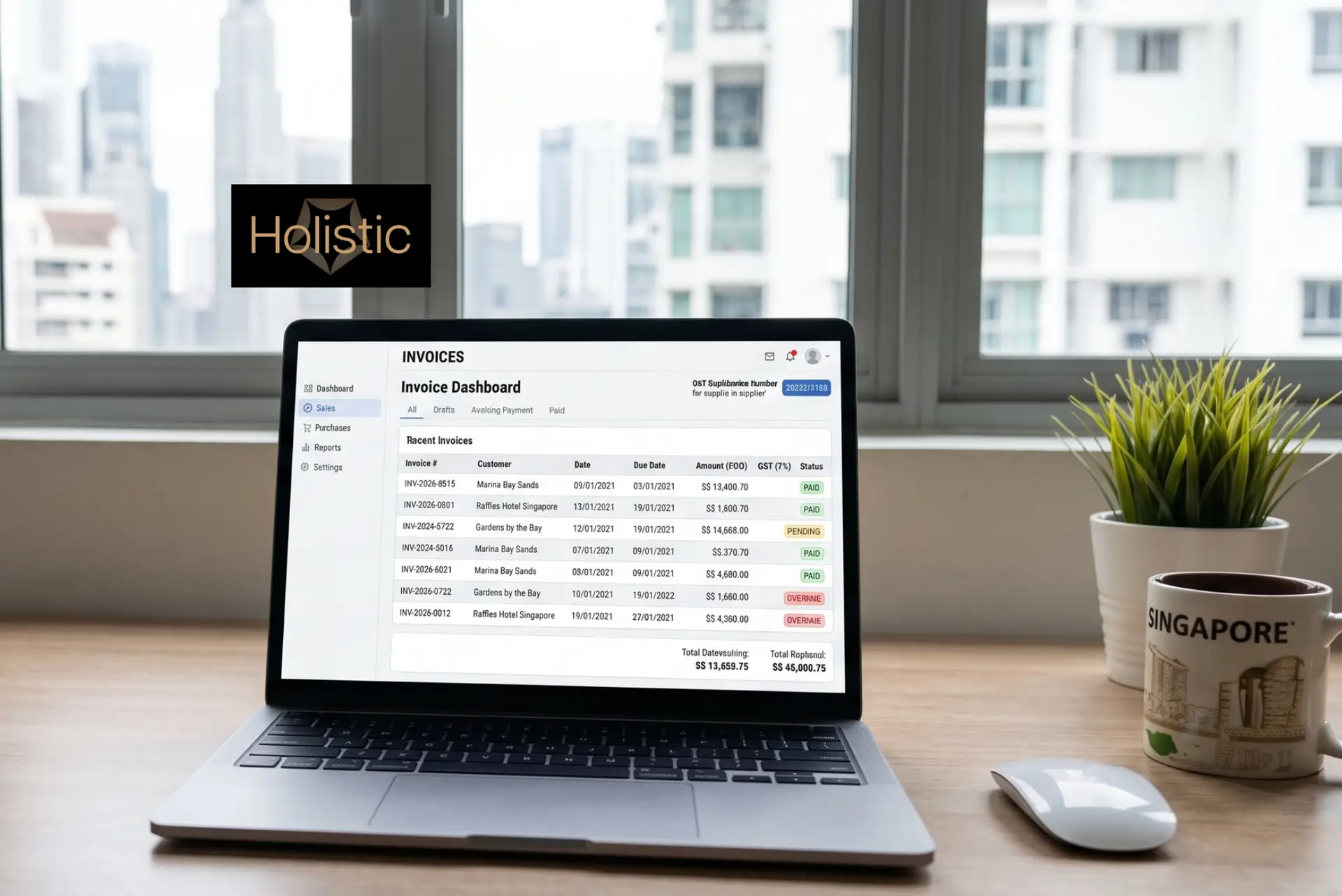
- InvoiceNow is Singapore’s nationwide e-invoicing network, introduced by IMDA in 2019 on the international Peppol standard.
- The GST InvoiceNow Requirement began with selected voluntary GST registrants on 1 November 2025 and 1 April 2026. It will progressively extend to all remaining in-scope GST-registered businesses from 1 April 2028 to 1 April 2031.
- Overseas entities and businesses registered for GST wholly because of the Reverse Charge regime are excluded.
- You are onboarded through an accredited provider, not directly by IMDA or IRAS. Provider charges vary, though qualifying free-of-charge packages run through to 31 March 2031.
- Support runs from fixed S$1,000 and S$5,000 GST InvoiceNow Transition Grants to a S$25,000 Queen Bee Grant for larger enterprises.
If your business is GST-registered and does not fall within an excluded category, note that InvoiceNow is shifting from an optional productivity tool to a phased compliance requirement.
At the Committee of Supply debate on 26 February 2026, the Government set out a schedule requiring all in-scope GST-registered businesses to submit invoice data directly to the Inland Revenue Authority of Singapore (IRAS), progressively from April 2028 to April 2031.
Meanwhile, the November 2025 and April 2026 requirements are already operative, and this article covers how InvoiceNow works and explains its rollout timeline, exclusions, registration, and grants. Read on to learn more and stay compliant!
What Is InvoiceNow and How Does This Affect GST-Registered Businesses?
InvoiceNow is Singapore’s nationwide e-invoicing network, introduced by the Infocomm Media Development Authority (IMDA) in 2019. InvoiceNow enables a structured invoice to be sent from one business’s accounting system into another’s and, once the feature is switched on, a copy of the required data to IRAS.
Within this network, invoices are also sent and received in a structured digital format based on Peppol, an open international standard.
As of 26 February 2026, the network carried over 63,000 businesses and the upcoming rollout should add some 90,000 more.
Singapore is the first Peppol Authority outside Europe, so an InvoiceNow transaction in Singapore can potentially reach Peppol-connected organisations in Australia, New Zealand, Japan and Europe—depending on the counterparty, document specification and providers.
A standard PDF is not a structured e-invoice: the data may need manual entry or extraction software before it reaches the recipient’s ledger. On the Peppol network, invoices are transmitted between accredited Access Points over secured connections, with encryption under the Peppol security framework.
For GST purposes, IRAS has added a fifth corner to the four-corner Peppol model. Once a business activates the InvoiceNow IRAS submission feature, the required data goes to IRAS.
This layer sits on top of ordinary invoicing: it does not replace GST returns or remove record-keeping obligations. All in-scope GST-registered businesses must be transmitting to IRAS by 1 April 2031. For more details, head to the IMDA InvoiceNow page and the IRAS InvoiceNow requirement page.
Benefits of InvoiceNow
IRAS and IMDA describe these as expected benefits of GST InvoiceNow, not guaranteed outcomes for all companies:
- Less manual work: Invoice data flows into the buyer’s system, which can cut data entry, reconciliation and error rates.
- Potentially shorter payment cycles: Structured invoices can be processed faster, though timing still depends on approval workflows, contractual terms and disputes.
- Quicker audits and refunds: As IRAS already holds the data, GST audits and eligible refunds may come sooner, and some solutions flag GST wrongly charged by a non-GST-registered supplier.
InvoiceNow Implementation Timeline
Participation is phased, with smaller businesses onboarding first, while larger ones fold the implementation into IT refresh cycles. Thresholds are generally set using GST return figures for accounting periods ending in 2025.
The IRAS GST InvoiceNow schedule is as such:
| Implementation Date | Businesses Involved |
| 1 Nov 2025 | Companies registering for GST voluntarily within six months of incorporation |
| 1 Apr 2026 | All new voluntary GST registrants, whatever their incorporation date or structure |
| 1 Apr 2028 | All new compulsory GST registrants; existing businesses with total annual supplies of S$200,000 or less |
| 1 Apr 2029 | Existing GST-registered businesses with total annual supplies of S$1 million or less |
| 1 Apr 2030 | Existing GST-registered businesses with total annual supplies of S$4 million or less |
| 1 Apr 2031 | Existing GST-registered businesses with total annual supplies above S$4 million |
The April 2026 phase ignores structure, so just as a private limited company will be required to onboard, so will a sole proprietorship or partnership registering voluntarily.
Businesses that are excluded: Two groups are exempt from the InvoiceNow requirement even if GST-registered: (i) overseas entities, including overseas vendors under the Overseas Vendor Registration (OVR) Pay-only and full regimes; and (ii) businesses liable to register wholly because of the Reverse Charge regime. But note the nuance: a foreign-incorporated business with a Singapore branch is not automatically excluded, and a Singapore business is not excluded merely by having an overseas branch!
How to Register for InvoiceNow

You do not apply to IMDA or IRAS directly for InvoiceNow. An accredited provider registers you in the SG Peppol Directory, where your Peppol ID derives from your UEN. Provider costs vary: subscription, integration or transaction fees may apply, though qualifying free-of-charge packages run through to 31 March 2031. Take note that processing times vary, so always confirm before committing.
Using off-the-shelf accounting or finance software:
- Check IMDA’s accredited InvoiceNow-Ready Solution Provider (IRSP) list; many common platforms are covered, but verify yours.
- Ask the IRSP to register you and issue your Peppol ID.
- Enable the GST InvoiceNow submission feature to transmit data to IRAS.
Running an in-house enterprise or ERP system:
- Engage an IMDA-accredited Access Point Provider (AP) to connect your system.
- Ask the AP to register you and obtain your Peppol ID.
- Confirm the IRAS connection is live and the submission feature is enabled.
In-house connection and testing can take three months to a year, so start early. Onboarding spans finance, tax and IT, and the leadership style you bring shapes how smoothly staff and vendors adapt.
Grants and Free-of-Charge Solutions for GST-Registered Businesses

IMDA and IRAS have worked with InvoiceNow-Ready Solution Providers (IRSP) to make free-of-charge solution packages available to GST-registered businesses until 31 March 2031. That said, businesses should check the latest provider list, as the availability period may vary by individual packages. Case in point, the current provider/package list is valid until 31 March 2027, and IRAS/IMDA will update the details for the period from 1 April 2027 to 31 March 2031.
GST InvoiceNow Transition Grant of S$1,000
Available from 1 July 2026 to 31 March 2030, or until the grant is fully claimed. Eligible applicants must be GST-registered businesses with total annual supplies of S$4 million or less in all prescribed accounting periods ending in calendar year 2025.
They must not already be subscribed to an IRSP or have their own solution connected to InvoiceNow, and must not have used an IRSP solution during the preceding three months. They must also purchase at least 12 months of services from an accredited IRSP or integrate their own ERP solution through an accredited AP after 26 February 2026. GST InvoiceNow must be activated and invoice data submitted to IRAS before the business’s mandatory implementation deadline. The fixed S$1,000 payout is made through PayNow Corporate.
GST InvoiceNow Transition Grant of S$5,000
Available from 1 July 2026 to 31 March 2028, or until fully claimed. It applies to GST-registered businesses with total annual supplies above S$4 million that operate their own ERP solution and integrate it with GST InvoiceNow through an IMDA-accredited AP. The implementation project must start after 26 February 2026, be completed within 12 months and finish by 31 March 2028. Completion includes activating GST InvoiceNow and submitting invoice data to IRAS. The payout is a fixed S$5,000 regardless of the actual qualifying cost.
InvoiceNow Queen Bee Grant
Qualifying large enterprises may receive a S$25,000 cash grant to connect their custom ERP solutions to InvoiceNow and encourage InvoiceNow transactions across their supplier or customer networks.
Among other conditions, the business must have been incorporated for more than a year, have annual turnover above S$4 million, have at least 200 suppliers or 200 business customers and connect through an IMDA-accredited AP. Integration must begin from 1 July 2026 and be completed by 31 March 2030.
That’s not all. The business must also receive InvoiceNow invoices from at least 20 suppliers or send them to at least 40 customers by 31 March 2031. Previous recipients of the LEAD Connect or LEAF Chain Leader grants are not eligible.
Productivity Solutions Grant
Eligible SMEs can receive support of up to 50% of qualifying software subscription costs when adopting pre-approved solutions.
Integration costs vary, so compare the grant against quotations from your AP and vendors!
Where grants do not cover the full implementation costs, businesses may consider other suitable financing options, such as a business term loan, a working capital loan or a business expansion loan.
⚠️ As always, it’s best to first confirm terms on the IMDA InvoiceNow grants page before committing to a provider or implementation project. Grant eligibility, application windows and payout conditions are subject to IMDA’s latest grant terms and availability.
Frequently Asked Questions
What is e-Invoicing and how does it differ from paper invoicing?
E-invoicing is the exchange of invoices as structured data between finance systems. A paper invoice or PDF is read by a person and may first require manual entry or extraction software. An e-invoice on the Singapore InvoiceNow network arrives as machine-readable data, automatically populating the recipient’s records.
What are the benefits of e-invoicing?
Fewer errors, less manual entry and reconciliation, and potentially shorter payment cycles, of course! InvoiceNow GST reporting may also bring faster audits, quicker eligible refunds and automated checks that catch wrongly charged GST early.
How does InvoiceNow work?
Your solution passes the invoice to your Access Point Provider, which routes it over the Peppol network to your customer’s Access Point and finance system. When the GST feature is enabled, the required data is also sent to IRAS via API, including relevant out-of-network invoices recorded in your connected system. All in all, it helps to streamline and digitalise mundane paperwork and processes.
Is InvoiceNow mandatory in Singapore?
Yes, for in-scope GST-registered businesses from their applicable implementation date. They must use an InvoiceNow-Ready Solution to transmit the required invoice data to IRAS, including relevant data from invoices processed outside the Peppol network.
How will the invoice data transmitted to IRAS be stored?
IRAS stores the data in its own systems, which are governed by public-sector security requirements. It says it is committed to safeguarding the confidentiality and security of taxpayer data; its Data Protection Statement and Privacy Statement explain in detail how data is handled. Transmission is encrypted under the Peppol security framework.
