

Key Takeaways
- Supply chain finance helps suppliers get paid earlier while allowing buyers to extend their payment terms.
- It is commonly known as supplier finance, supplier financing, reverse factoring, or payables finance.
- Banks and trade finance providers are the usual providers of supply chain finance in Singapore.
- Supply chain finance works best when there is a strong buyer, reliable invoices, and suppliers who want faster cash flow.
- SMEs that do not qualify for supply chain finance may still consider other financing options, such as business term loans, working capital loans, or startup business loans.
Cash flow can feel like oxygen for a business: you only notice how important it is when there is not enough of it. That is where supply chain finance comes in. If you have ever wondered, “What is supplier financing?” think of it as a practical arrangement that helps suppliers receive payment earlier, while buyers get more breathing room before making payment.
In Singapore, many companies explore supply chain finance solutions to improve liquidity, strengthen supplier relationships, and keep operations moving smoothly without putting unnecessary pressure on their working capital.
What Is Supply Chain Finance in Banking?
Supply chain finance in banking is a financing arrangement in which a bank or other financier pays a company’s suppliers earlier than the original invoice due date. The buyer then pays the financier later, based on the agreed payment terms.
In simple words, the supplier gets cash faster, the buyer keeps more cash in the business for longer, and the financier earns a fee or interest for providing the service.
This structure is also often called a supplier finance arrangement because it is built around improving payment flows between buyers and suppliers.
You just need to know that there are three key players in this setup: the buyer, the supplier, and the financier. The buyer is usually the company purchasing goods or services. The supplier provides those goods or services and issues an invoice. The financier, often a bank, pays the supplier early once the invoice is approved.
Instead of chasing the buyer for payment, the supplier can receive funds sooner and focus on production, hiring, inventory, or day-to-day operations.
Is There Another Name for Supply Chain Finance?
Yes, and this is where many business owners get confused. Supplier finance and supplier financing are often used interchangeably with supply chain finance, although some banks may define their products slightly differently.
Other common names include:
- reverse factoring
- payables finance
- approved payables finance
- supplier payment finance
The term “reverse factoring” is especially useful to understand.
In traditional factoring, the supplier usually sells its invoices to a financier.
In reverse factoring, the buyer is the stronger party that helps initiate the financing arrangement. Because the financier may assess the buyer’s credit strength, suppliers can sometimes access funding at more competitive rates than they might otherwise.
Why Do We Need Supply Chain Finance?

Most business owners would know that payment timing is rarely perfect. This then leads to a demand for supplier financing. A supplier may need cash today to buy raw materials, pay salaries, or fulfil the next order, but the buyer may only pay invoices in 30, 60, or even 90 days.
That delay can create stress, especially for SMEs that do not have large cash reserves sitting in the bank. Just so you know, even a profitable company can run into trouble when money is stuck in unpaid invoices!
For buyers, supplier financing can also be useful because it supports healthier supplier relationships. Imagine a large buyer pushing for longer payment terms while its smaller suppliers struggle to survive. That creates tension, delivery risks, and possible supply disruption. With supplier finance, the buyer can maintain or extend payment terms while giving their suppliers an option to receive early payment. If it helps, think of supplier finance as building a bridge between two distinct cash flow needs.
Understanding Supplier Financing
At its core, supplier financing is a technology-enabled working capital solution. The process usually starts after the supplier delivers goods or services and submits an invoice. Once the buyer approves the invoice, the supplier may choose to receive early payment from the financier, usually at a small discount or financing cost. The buyer then pays the financier on the original or extended due date.
Benefits for Suppliers
For suppliers, the biggest benefit is liquidity. Instead of waiting months for payment, they can unlock cash quickly and use it to keep the business moving.
This can be especially helpful for suppliers with tight margins, seasonal demand, or large purchase orders that require upfront spending. Faster payment can also reduce reliance on overdrafts or expensive short-term borrowing.
Benefits for Buyers
For buyers, the benefit is improved cash flow control. They may be able to negotiate longer payment terms while still supporting suppliers with early payment access. This can improve working capital, preserve cash for business expansion, and reduce the risk of supplier failure.
When executed properly, supply chain finance solutions create a win-win arrangement rather than simply shifting pressure from one party to another.
How Supply Chain Finance Works
First, the buyer purchases goods or services from the supplier.
Next, the supplier issues an invoice to the buyer. The buyer verifies and approves the invoice.
Once approved, the supplier can request early payment from the bank or finance provider. The financier pays the supplier, minus any applicable fee or discount.
Later, the buyer pays the financier according to the agreed payment date.
The process is usually fairly straightforward:
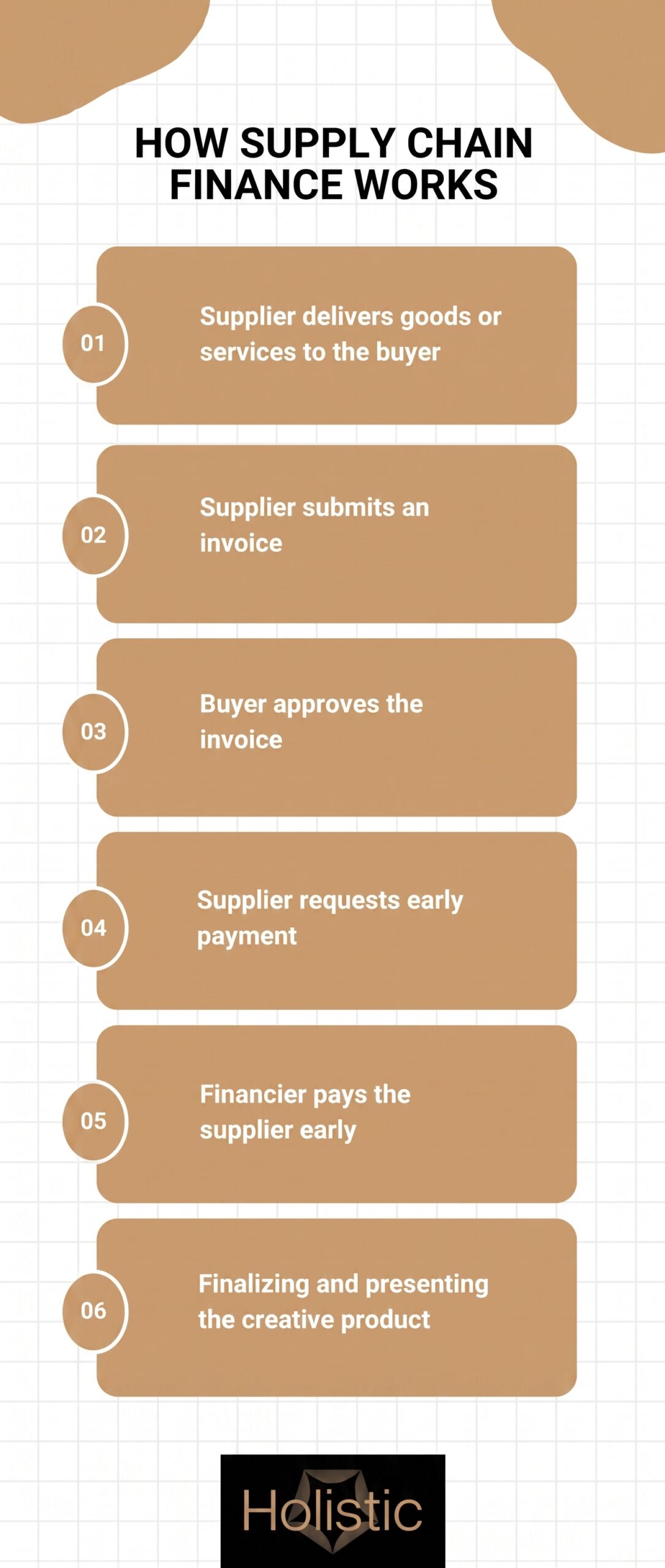
Here’s an example:
A Singapore supplier issues a S$50,000 invoice to a larger buyer with 60-day payment terms.
The supplier does not want to wait two months because it needs cash to purchase materials for another project.
Under a supplier finance arrangement, the bank pays the supplier earlier, perhaps within just a couple of days after invoice approval. The supplier receives cash sooner, while the buyer pays the bank later on the agreed date.
Supply Chain Risk Management
Identifying Risks
While supply chain finance can be useful, it should not be treated as magic money. Businesses still need to manage risks carefully.
Common risks include supplier dependency, buyer credit risk, late invoice approvals, documentation errors, and overreliance on financing to cover deeper cash flow problems.
Warning: If a company uses supplier finance only to delay painful financial decisions, the arrangement may hide issues rather than solve them!
Strategies for Mitigation
Good risk management starts with clear processes.
Buyers should approve invoices promptly, communicate payment terms clearly, and avoid stretching suppliers beyond reasonable limits.
Suppliers, on the other hand, should fully comprehend the financing cost, compare it with other funding options, and avoid assuming every invoice will automatically qualify for supplier financing.
For larger companies, transparency matters. Supplier finance deals can change how people see liabilities and cash flow.
Where Can You Get Supply Chain Finance Solutions?

Available Supply Chain Finance Banking Solutions in Singapore
In Singapore, supply chain finance solutions are commonly available through major local and international banks. Providers may offer supplier finance, distributor finance, receivables finance, payables finance, and digital trade platforms.
Banks such as DBS, UOB, and HSBC offer trade and supply chain finance solutions designed to help companies optimise working capital and manage payment flows.
In case you’re wondering, the right Singapore supply chain finance option depends on your business structure. For instance, a larger buyer with many suppliers may need a full supplier finance programme. An SME supplier may be more interested in invoice financing, working capital loans, or other short-term facilities. A distributor may need receivables financing instead of payables financing.
Before choosing a product, spend some time comparing eligibility, financing cost, approval speed, documentation requirements, and whether your buyers or suppliers are willing to participate.
Comparison of Solutions
| Solution Type | Best For | Main Benefit |
| Supplier finance | Buyers with regular suppliers | Helps suppliers get early payment |
| Distributor finance | Distributors and resellers | Supports inventory and sales cycles |
| Invoice financing | SMEs with unpaid invoices | Unlocks cash from receivables |
| Working capital loan | SMEs needing flexible cash flow | Funds operations, payroll, or stock |
| Business term loan | Growth-focused companies | Supports expansion or larger expenses |
Conclusion: Is Supply Chain Finance Right for You?
Supply chain finance is a practical way to improve cash flow across the buyer-supplier relationship. Suppliers can get paid earlier, buyers can manage payment terms more strategically, and financiers help bridge the timing gap. When used properly, it can strengthen supply chains, reduce liquidity pressure, and support smoother business operations altogether!
That said, supply chain finance is not always the best fit for every SME. If your company does not have approved invoices from eligible buyers, or if you need quick funds for marketing, renovation, hiring, expansion, or startup costs, other financing routes may make more sense.
Holistic Enterprise can help businesses compare options such as business term loans, working capital loans, business expansion loans, and startup business loans.
Apply now or contact Holistic Enterprise to explore the right business financing solution for your next stage of growth.
Read these next:
- Best Corporate Bank Accounts in Singapore
- Comparing Business Loans for SMEs: DBS, Maybank, OCBC & UOB
- Best Small Business Loans in Singapore
- The Top SME Grants in Singapore
- Understanding Business Loan Interest Rates in Singapore
- Guide to GST Registration for Companies in Singapore
